This is a strange time to be learning reverse engineering. We are studying assembly, debuggers, decompilers, calling conventions, and operating-system fundamentals while agents are already beginning to work directly with binaries.
This is no longer a future scenario. Agents can inspect pseudocode, summarize functions, follow cross-references, move from strings into specific code paths, and combine information from several analysis tools inside the same investigation.
REA — Reverse Engineer Anything — is one example of that shift happening now.
So the question is no longer whether AI will be able to do reverse engineering. It already does part of it. The more useful question is how that changes the work of the reverse engineer.
##What Is REA?
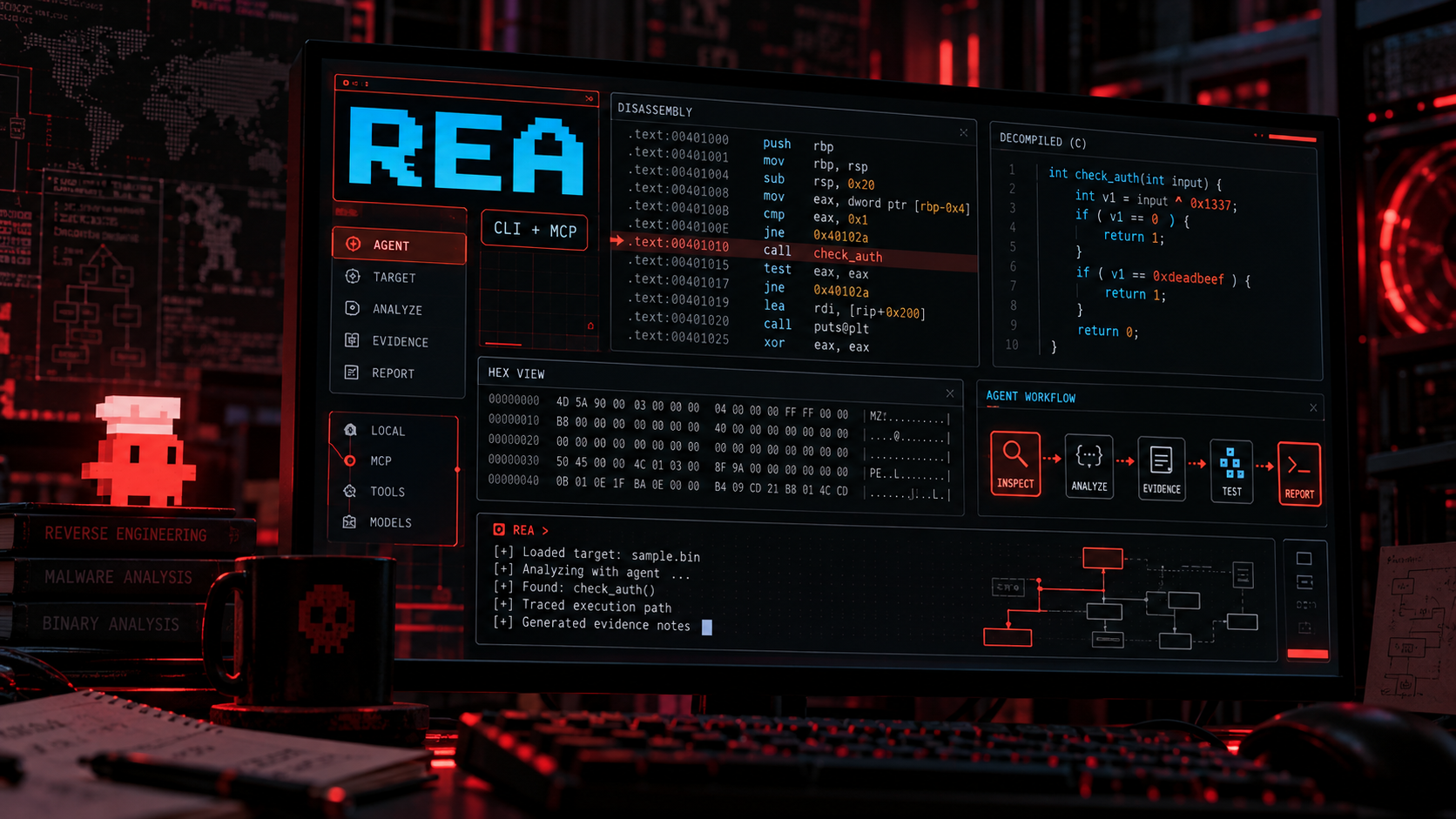
REA is an MCP- and CLI-based project that exposes reverse-engineering tools to agents. It can work with native binaries as well as JavaScript/Electron applications and .NET assemblies. For native analysis, it can use engines such as Hopper, Ghidra, or IDA.
The agent is not limited to asking for one isolated result. It can move between functions, pseudocode, assembly, strings, and references while keeping the investigation going. REA also tries to keep evidence, limitations, and unknowns attached to its conclusions.
That distinction matters. Saying that a function collects credentials is one thing. Showing which calls, strings, or data flow support that interpretation is another.
IMAGE PLACEHOLDER 1: Real REA CLI / MCP investigation view.
##Do We Still Need Manual Reverse Engineering?
Today, yes. But defending manual reverse engineering by listing the things REA or another agent cannot do is not a strong argument. A problem that is difficult today may be solved a few model releases from now. Another agent may handle it better, or the disassembler itself may eventually include the same capability.
We can already see the beginning of this shift. Function explanations, renaming suggestions, cross-reference exploration, reasoning over pseudocode, string triage, and investigation of specific control-flow paths can all be assisted by agents today.
The question is not whether those tasks will be automated. The real change is how much of them the analyst will still perform directly by hand.
Manual knowledge still matters, but for a slightly different reason. If an agent gives the correct answer, we need enough understanding to know why it is correct. If the answer is wrong, we need to recognize that. And when two findings disagree, someone still has to go back to the code.
It is difficult to verify an explanation of assembly without understanding assembly. The same is true for control flow, calling conventions, memory behavior, and the rest of the fundamentals.
IMAGE PLACEHOLDER 2: Real REA result showing evidence, limitations, or a function investigation.
##Will the Manual Part Shrink?
Most likely, yes. In some areas, it already has.
First-pass binary analysis, function classification, renaming, string tracing, and basic code-path exploration are already benefiting from automation. Spending hours manually building a map that an agent can produce in seconds will not always make sense.
I find that a little sad. There is something satisfying about moving through a binary slowly, making the connections yourself, and finally watching the behavior fall into place. That part of the work may become less common in everyday analysis.
But a tool doing a procedure faster does not make the knowledge behind that procedure useless. It changes where that knowledge is applied.
##What If We Are Only Just Starting?
For people entering malware analysis and reverse engineering now, the situation feels unusual. We are learning to walk while the ground is moving. A debugging technique can become partly automated while we are still learning it, and an agent can produce a reasonable first explanation of a function we may have spent a long time studying manually.
That makes it easy to wonder whether we arrived too late.
I do not think timing is the problem. We are not behind; the starting line has changed.
We are beginning with tools that did not exist for people who learned reverse engineering years ago. At the same time, we will face systems and problems they never had to think about. The fundamentals may remain familiar, but the daily workflow built on top of them does not have to stay the same.
That does not make the path worse. It simply means the field is not standing still while we learn it.
##Will We Run Out of Things to Reverse?
There is no guarantee that reverse engineering will look the way it does today forever. A major change in the daily work is much more realistic, and we are already seeing the first signs of it.
But analysis tools are not the only technology moving forward. New runtimes, processor architectures, firmware, protocols, operating-system layers, and obfuscation techniques will continue to appear. Malware authors will keep changing their methods. AI systems themselves are becoming another technical target whose internals, behavior, and security boundaries need to be understood.
When one layer becomes easier to analyze, curiosity moves to another.
I do not think we will struggle to find things to reverse. What changes will be what we reverse and how we do it.
##Where Does the Analyst's Role Move?
If automation removes some of the mechanical work that consumes a reverse engineer's time today, the job will not simply become “writing prompts.”
An agent can produce dozens of findings about a sample. Someone still has to decide which function matters, which behavior is relevant to the wider campaign, and which conclusion was built on a bad assumption.
That makes forming hypotheses, comparing evidence, combining results from different tools, and knowing when to go back to manual analysis even more useful.
The reason for learning the fundamentals may shift as well. Assembly is not only useful because we want to follow every instruction by hand. It also gives us the ability to check an agent's interpretation when something does not look right. Debugging does not have to mean manually stepping through an entire program; it may become the tool we use to verify one suspicious part of an automated investigation.
It can still be the same profession, just with a different daily workflow.
##Looking at REA This Way
Seeing REA as “the tool that ends reverse engineering” is too simple. Dismissing it with “it cannot replace a human” is not very useful either.
What REA shows is more concrete: traditional reverse-engineering engines can now become tools that agents operate directly. An agent can inspect pseudocode, return to assembly, follow references, collect evidence, and keep the findings together inside one investigation.
And there is no reason to assume these systems will stop improving here.
The useful response is not to watch that development from a distance. I would rather use the tools, understand where they are strong, and figure out how my own technical knowledge fits into the new workflow.
Manual knowledge and automation do not have to be opposites. For now, the strongest approach may simply be knowing how to use both.
##Conclusion
I do not know what the daily work of reverse engineering will look like five years from now. Some of the tasks we spend hours on today will become far more automated, and some already are. It would not be surprising if the manual part of the workflow became smaller than it is now.
There is something a little sad about that. When a technique we are only beginning to learn becomes less central, it is easy to ask why we are learning it at all.
But I no longer see that as evidence that we started at the wrong time. We are learning while the field is changing, which means we get to learn the old foundations and the new tools at the same time.
The world we are starting in is simply different from the one that existed a few years ago.
Technology will keep moving. The best response is not to stand against that movement, but to learn how to use it.
And if something far more capable than REA appears one day, that is fine.
We will find another system to investigate. :)
##Source
REA — Reverse Engineer Anything
Stay with Malrev0x...