
##Encryption:
The process of making data unreadable by using a specific key or algorithm. Etymologically, the root “crypt” comes from the Ancient Greek word kryptos, meaning “hidden, secret, concealed.”
##Why Is Encryption Used In Malware?
It is not used for a single purpose. Although ransomware is usually the first example that comes to mind, malware families also use encryption to hide much smaller but still important components.
Seeing a C2 address, domain, IP address, file path, registry key, or command list directly inside a malicious binary is a major advantage for an analyst. This information helps reveal what the malware communicates with, where it persists on the system, or what behaviors it may perform. For this reason, attackers do not want to leave such important information openly visible inside the binary. This is where encryption comes into play.
For example, a loader may store the actual payload as an encrypted data block instead of keeping it openly on disk. At runtime, it decrypts this data, writes it into memory, and then redirects the execution flow to that new region. Similarly, a stealer may keep its C2 address or the configuration it uses to send collected data in encrypted form. As a result, during static analysis, the analyst sees unreadable data blocks instead of meaningful strings.
At this point, for a malware analyst, the main question comes before Which encryption algorithm was used?:
What is the encryption being used to hide?
Because the fact that AES, RC4, XOR or another algorithm was used is not enough on its own. What matters is what data was encrypted, where the key is stored, where the decryption takes place, and how the decrypted data is used afterward.
A small distinction should be made here. In malware analysis, the term encrypted data does not always mean strong cryptographic encryption. In some samples, data may only be hidden through XOR, encoding, compression, or custom obfuscation. From an analyst’s perspective, in the first stage, what matters is not only the name of the technique, but the fact that the data is hidden and how it is recovered at runtime.
Therefore, encryption in malware analysis is not only a cryptological topic; it is also directly related to behavioral analysis. A decryption routine can reveal not only the hidden data, but also the malware’s real purpose. That is why this area requires behavioral tracking as much as static analysis.
##What Kind Of Data Can Be Hidden Inside Malware?
| Hidden Data / Element | Meaning For The Analyst |
|---|---|
| Strings | Function names, error messages, and URLs may be hidden |
| Config | Information such as C2, campaign ID, mutex, and bot ID may be extracted |
| Payload | Unpacking or second-stage analysis may be required |
| Network Traffic | C2 communication may not appear in plaintext |
| API Names | Dynamic API resolving or API hashing may be involved |
| User Files | This may indicate ransomware behavior |
##What Does The Analyst Look For?
When we suspect that encryption or data hiding is used in a malware sample, simply looking at unreadable byte sequences is not enough. The analyst should track which functions read this data, what transformations it goes through, and for what purpose it is used within the malware’s execution flow.
###Suspicious Data Blocks
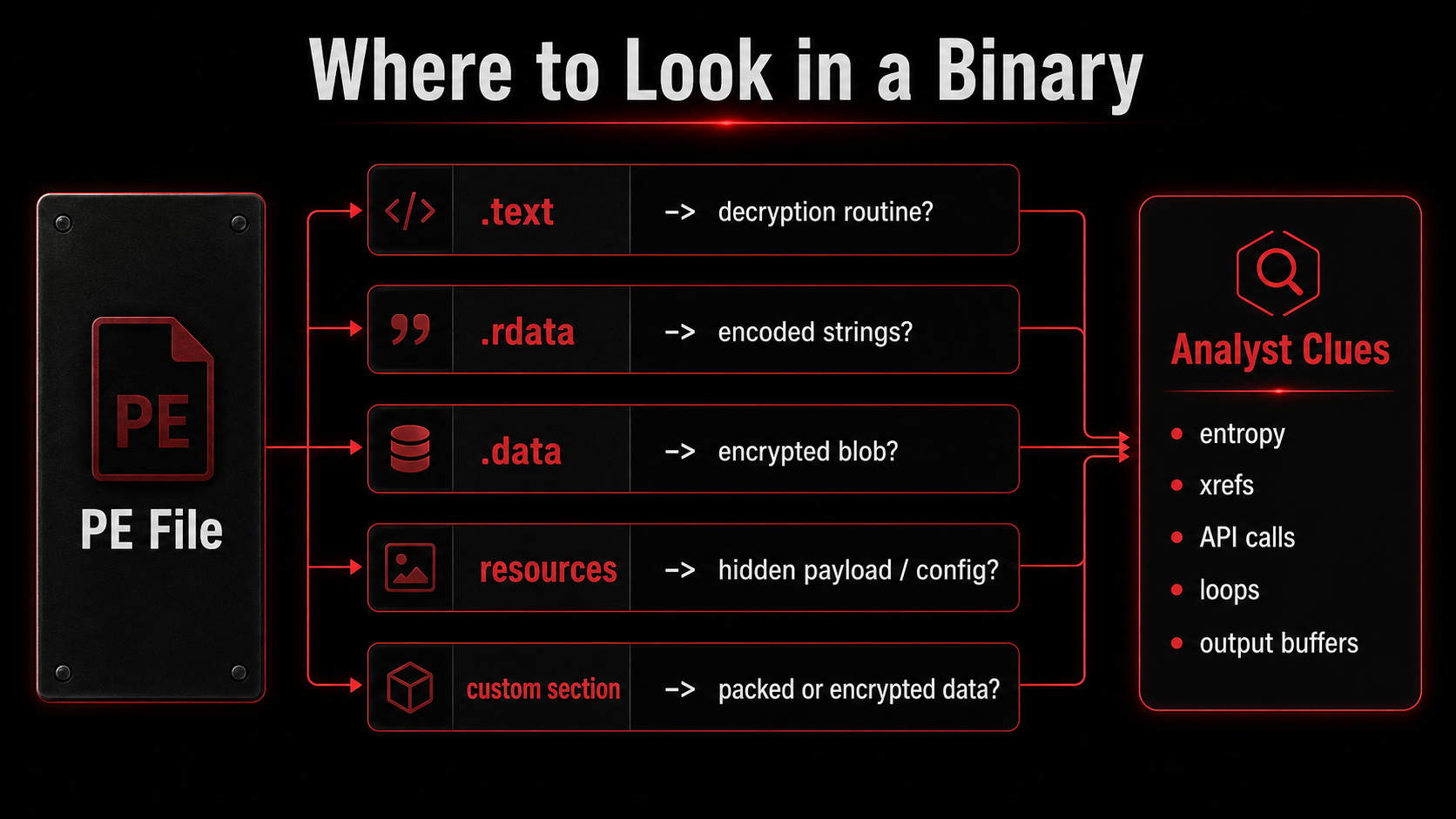
One of the first places to examine is the static data areas inside the binary. Instead of meaningful strings, random-looking byte sequences may appear in sections such as .data, .rdata, the resource section or sections with unusual names. This data alone is not sufficient evidence, but when it appears together with high entropy, the possibility of encrypted, compressed, or obfuscated data becomes stronger. At this point, what matters is where this byte sequence is located inside the binary and how it is used by the code.
###The Code That Accesses This Data
Secondly, the code flow that accesses this data is followed. If a function reads the same data block, processes it through a specific loop, performs XOR-like operations, uses fixed tables or calls Windows Crypto APIs, there may be a decryption routine at that point.
APIs such as CryptDecrypt and BCryptDecrypt can provide direct clues for decryption behavior. Functions such as CryptCreateHash and BCryptHashData may indicate hashing operations or a stage in a key-derivation chain. However, not every malware sample uses these APIs. Some samples embed their own decryption routines directly inside the binary. Therefore, looking only at API calls is not enough; loop structures, fixed key usage, byte-level operations, and transformations performed on buffers should also be examined.
###Where The Key Comes From
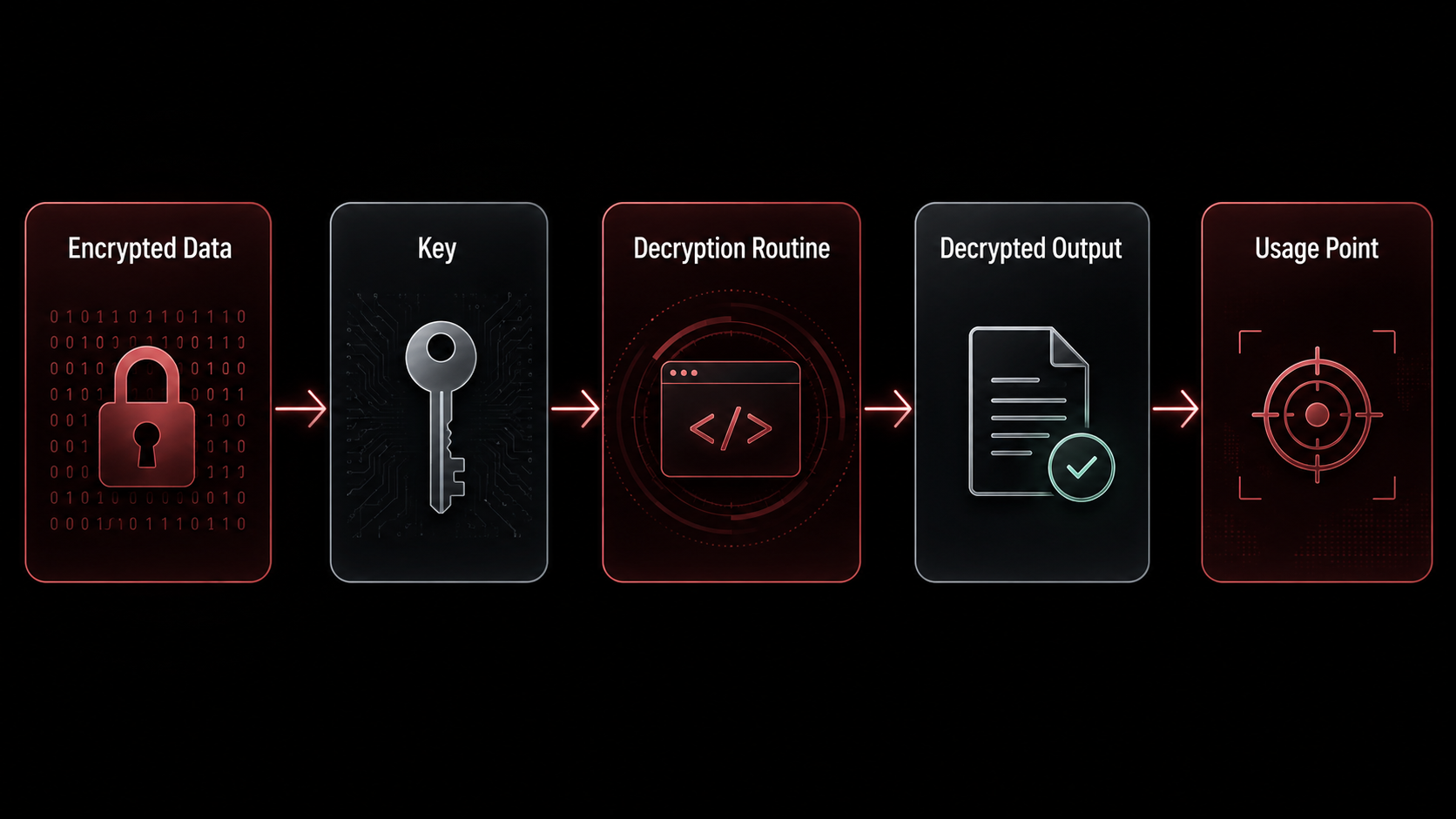
Thirdly, the source of the key is examined. Sometimes the key is hardcoded inside the binary. Sometimes it is derived from a string, system information, a config field, or data received from the network. This distinction is important because a hardcoded key can be extracted directly during analysis, while a runtime-generated key may require debugging or memory analysis to observe.
###Where The Decrypted Output Is Used
The final step is to examine how the output of the decryption operation is used. After the output is written to a buffer, is it read as a string, passed to a config parser, used for API resolving, written to a file, or used in network communication? This usage point reveals the real meaning of the encrypted data from the malware’s perspective.
Because the decrypted output may sometimes be only a hidden URL, while in other cases it may be a second-stage payload or the malware’s entire configuration structure. At this point, the goal is not only to find the encrypted data. The goal is to understand where the data is decrypted, which key is used, and what purpose the decrypted output serves in the malware’s execution flow.
The general analysis chain can be thought of as follows:
##Conclusion
In conclusion, encryption in malware analysis is not only a mathematical or cryptological topic. In many cases, it is a layer that hides the malware’s real intent, configuration structure, C2 information, or payload flow.
In the next article, I will cover the basic differences between encryption, hashing, and compression.
An analyst does not need to memorize the mathematical details of every algorithm. However, they should be able to track where the encrypted data is located, by which mechanism it is decrypted, and how it is used in the malware’s execution flow after being decrypted.
Stay with Malrev0x...